
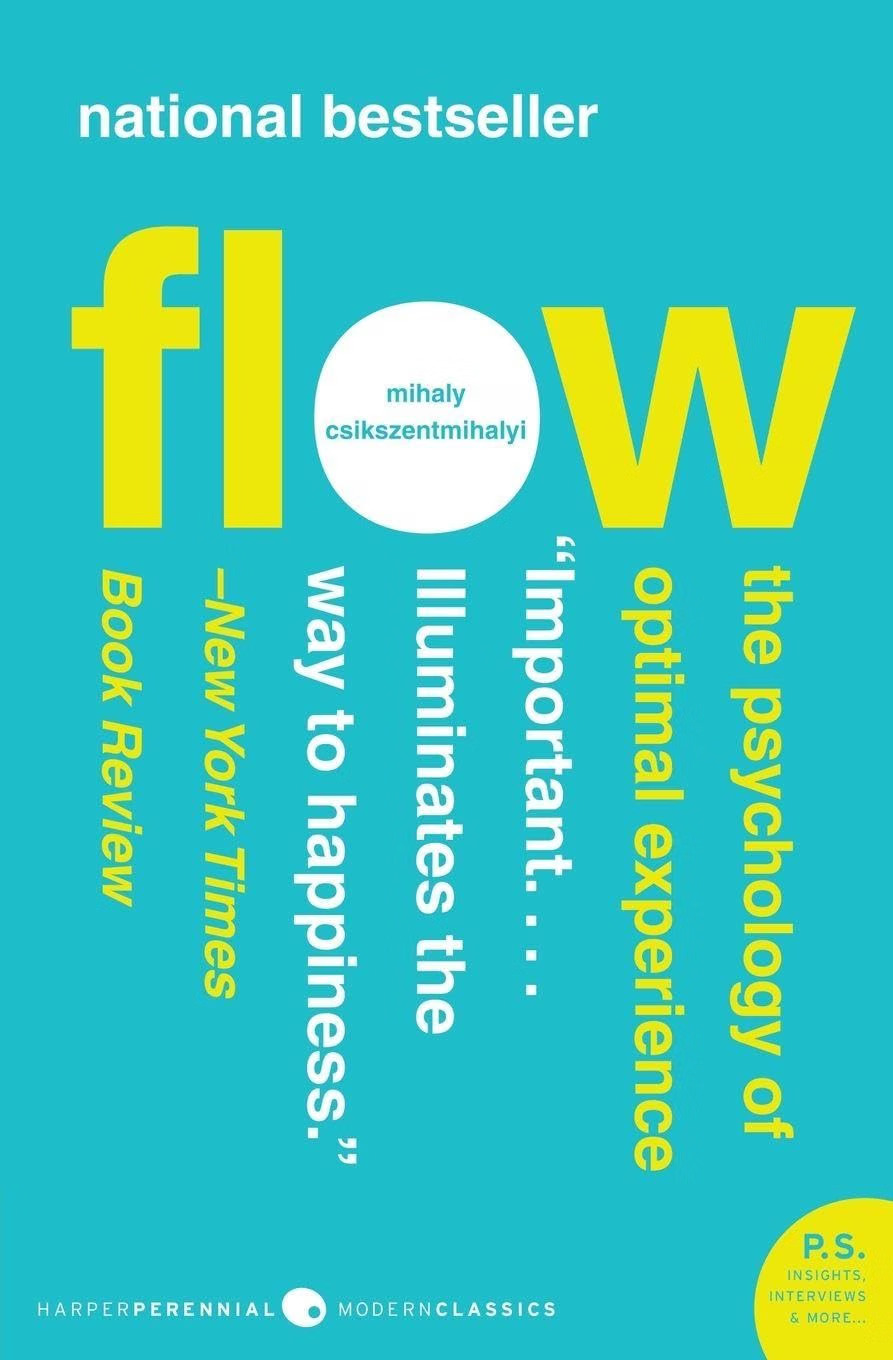
Once the basics are covered, we immediately want more: more money, more status, more comfort. Satisfaction keeps moving ahead of us, and the present is lived as waiting. Mihaly Csikszentmihalyi argues that well-being depends not on what we achieve but on how we organize our attention, and he offers a way to recognize when an experience helps us grow.
The book starts from a simple question: why does having more not translate into living better? To answer it, Csikszentmihalyi gathers accounts from chess players, climbers, surgeons and assembly-line workers, and describes what their best moments have in common. Within Eudaimanya it matters as the author's own psychological model of the quality of experience, with limits he himself points out.
If you remember only one idea
According to Csikszentmihalyi, the quality of a life depends on what we invest our attention in: enjoyment appears when a demanding challenge is matched to our abilities, not when we get more.
- Flow is a state of full concentration in which the challenge of the task and the person's skill are in balance; when they are not, boredom or anxiety appears.
- The author distinguishes pleasure, which restores a balance, from enjoyment, which demands attention and, in his view, increases the complexity of the person.
- Flow is a neutral energy: it can go into something constructive or turn into dependence, depending on what it serves.
Audiovisual analysis
Audiovisual summary and podcast on the book’s central ideas.
Key concepts
Seven Ideas for Understanding Flow
Before the analysis, it helps to fix the vocabulary Csikszentmihalyi uses to describe what makes an experience fulfilling and why attention sits at the center.
Flow
What it means: A state in which attention is given entirely to an activity whose challenge is matched to the skill of the person doing it.
Why it matters: According to Csikszentmihalyi, this is where the enjoyment arises that, in his model, gives experience its quality and makes the person grow.
Psychic energy (attention)
What it means: Attention understood as a limited resource: it selects, from millions of signals, the ones that enter consciousness.
Why it matters: In the author's view, where this energy is invested determines what consciousness contains and how personality takes shape.
Challenge and skill
What it means: The challenge is what the situation demands; the skill is what the person can do. Flow requires the two to be in balance.
Why it matters: When skill exceeds the challenge, boredom sets in; when it falls short, anxiety does. That is why the model works as a way of reading your own state.
Pleasure and enjoyment
What it means: Pleasure restores a balance or fulfills expectations without requiring attention; enjoyment comes from deliberate effort in the face of a challenge.
Why it matters: According to the author, only enjoyment adds complexity to personality; pleasure maintains the order that was already there.
Autotelic activity
What it means: From the Greek auto, "self," and telos, "goal": an activity done for the reward of doing it, not for money, status or to avoid punishment.
Why it matters: The author locates optimal experience in the shift from activities done for external rewards to ones done for their own sake.
Psychic entropy
What it means: Inner disorder that arises when what reaches consciousness clashes with a person's goals and forces them to spend attention on defending themselves.
Why it matters: According to the book, it leaves less attention for the task at hand and, if severe, can disintegrate the personality.
Differentiation and integration
What it means: Two movements of growth: moving toward what is one's own and unique, and connecting with other people, ideas and values.
Why it matters: According to the author, the two must be balanced: differentiation alone leads to selfishness; integration alone, to conformity.
The Book's Path
Problem
Getting more does not by itself improve inner experience
Common mistake
Pursuing happiness directly, or confusing pleasure with enjoyment
Thesis
Attention shapes both experience and the person
Framework
Flow: challenge and skill in balance, with eight dimensions
Application
Ask what I invest my attention in, and what for
Outcome
Greater personal complexity, according to the author
01 — Central thesis
Why Getting More Isn't Enough
Meeting our basic needs does not bring lasting calm. Once food, shelter and security are covered, new expectations of money, power or status appear. The goal moves ahead every time it is reached, and the present shrinks to a formality on the way to whatever comes next.
The usual assumption is that getting more will improve how we feel inside. Csikszentmihalyi argues the opposite: material progress and a more sophisticated environment do not by themselves ensure psychological well-being. To illustrate, he contrasts Cyrus the Great, who had ten thousand cooks while Persia went hungry, with modern households that have access to banquets without any greater satisfaction in life.
Nor does he believe the solution is to go straight after happiness. He draws on J. S. Mill's idea that asking yourself whether you are happy is enough to stop being so, and on Viktor Frankl's view that success must follow as an unintended side effect of dedicating yourself to something greater than yourself. As support, he gathers data on the American society of his day regarding crime, divorce and mental health, arguing that more resources do not by themselves improve the quality of experience.
Central thesis
According to Csikszentmihalyi, the quality of a life depends on what we invest our attention in, and the best experiences appear when a demanding challenge meets our abilities.
Flow here means a state in which attention is given entirely to what one is doing and the activity is lived as enjoyment. It is not a passive sensation: according to the author, it is reached through active engagement in complex tasks.
The following sections trace how this state comes about, what makes it up, what sustains it in the person, and where the book itself sets its limits.
02 — Core mechanism
Challenge and Skill: Where Flow Appears
We know two opposite kinds of bad experience: the task that falls short and bores us, and the one that overwhelms and unsettles us. Between the two lies a point where time passes without our noticing.
According to the author, what separates these states is the relationship between two variables. Challenge here means what the situation demands; skill, what the person is able to do.
When skill clearly exceeds the challenge, boredom appears. When the challenge exceeds skill, anxiety appears. And when the two are balanced at a demanding level, flow appears.
The diagram below shows this relationship.
The book also describes how to return to flow in each case. In the face of boredom, raise the challenge, restructure the task or look for more demanding goals; in the face of anxiety, develop the skills needed to match the demand.
He illustrates this with Alex, who starts playing tennis. With rudimentary skills and a simple challenge, getting the ball over the net, the two are in balance. With practice, the game begins to bore him; if he suddenly faces a far better opponent, he feels anxious. In both cases the way back leads him to a more complex flow than the first, because it calls for more skill to meet a greater challenge.
Flow, then, is not a static state but a moving frontier. According to the author, the search for enjoyment pushes a person out of boredom and anxiety again and again, and this expands the person's abilities.
03 — Main components
How Optimal Experience Feels
Enjoying something is not the same as having a good time. A good meal or a spell of rest satisfies a need and is welcome, but it rarely leaves the feeling of having changed.
Csikszentmihalyi frames this as a distinction between pleasure and enjoyment. Pleasure, according to the book, restores a lost balance, as when we relieve hunger or rest, or meets social expectations, and it does not demand concentrated attention. Enjoyment arises when we go beyond what was expected through deliberate effort, and it leaves the certainty that the person has grown stronger.
To describe how that enjoyment is experienced, the author organizes into eight dimensions what tends to accompany optimal experience. They are better recognized as traits than as steps: they do not form a method.
01
An achievable task
The demands of the action fall within the person's real abilities.
02
Concentration
Attention is focused entirely on the activity at hand.
03
Clear goals
The aim of the activity is defined at every moment.
04
Immediate feedback
Continuous signals arrive about whether the action is going well or badly.
05
Effortless involvement
Action and awareness merge, and performance flows spontaneously.
06
Sense of control
Fear of failure recedes, and one feels a mastery over uncertain situations.
07
Loss of self-consciousness
Concern for one's self-image is suspended.
08
Transformed time
Clock time loses its importance: hours seem like minutes.
The accounts in the book illustrate this. A chess player compares concentration to breathing, something you never think about. An assembly-line worker turns a repetitive 43-second task into a quest for his own record, bringing it down to 28, and describes a deep satisfaction. Surgeons, among other reasons, prefer operating because they can see at once whether the procedure went well.
To classify the activities that alter experience in a pleasurable way, the author adopts the typology of games devised by the anthropologist Roger Caillois: competition (agon), chance (alea), vertigo (ilinx) and imitation or fantasy (mimesis). Chess, roulette, skydiving and theater are examples of each.
Recognizing these traits helps explain why some tasks absorb us and others do not, even when they demand a similar effort.
04 — Deeper layer
Attention as the Energy That Builds the Self
For centuries, myths, religions and traditions gave people the sense of having a place in a cosmos that, according to the author, is indifferent to our goals. When rationalism wears down that confidence, existential anguish is laid bare. Hence the book shifts its focus from mastering the outside world to ordering inner experience.
For Csikszentmihalyi, consciousness is not a passive mirror: it represents what happens inside and outside the organism so that it can be evaluated and acted on. And its capacity is limited. According to research the book cites, the mind can process at most about 126 bits of information per second, or around seven stimuli at once, which over a seventy-year life amounts to a finite quantity of experience.
That is why the author calls attention psychic energy: here it means the limited resource with which we select which signals matter out of millions of possible ones. Without investing it there is no mental work, and where it is invested determines what consciousness contains.
That investment also builds the person. In the book's model, personality is the set of contents of consciousness together with the hierarchy of goals accumulated over time. Attention shapes it by choosing which experiences go into it, and personality, with its goals, in turn directs attention. Sam Browning, a teenager who came across Bermuda's coral reefs by accident, reorganized his goals and his attention until he set his sights on becoming a marine biologist.
When what reaches consciousness clashes with what the person wants, the book speaks of psychic entropy: an inner disorder that forces attention to be spent on defending the self. The case of Julio Martinez illustrates it: worry about a flat tire on his car kept him from keeping pace with the assembly line and made him irritable with his coworkers.
The opposite state is, for the author, an inner order in which information is consistent with one's goals and energy flows without friction: this is flow, which he also calls psychic negentropy.
According to Csikszentmihalyi, repeated experiences of flow increase the complexity of personality through two movements. Differentiation moves toward what is one's own: uniqueness, autonomy and distinctive skills. Integration moves toward connection with other people, ideas and values. A personality focused only on differentiating risks sliding into selfishness, and one given over only to integrating, into conformity.
This distinction connects with what the book says about motivation. An autotelic activity is one done for its own reward, and an exotelic one is done for external rewards such as money, status or avoiding punishment. According to the author, most behavior starts out exotelic, and optimal experience appears when the activity becomes autotelic and finds its purpose in the experience itself.
05 — Limits and failure conditions
A Neutral Energy and Its Obstacles
A model that celebrates concentration needs clear limits, and the book itself points them out.
A morally neutral energy
According to the author, flow is not good in itself: concentrated psychic energy can be applied to destructive ends. He cites veterans who describe the front line as a state of absolute concentration, and the technical fascination of Oppenheimer, who called the atomic bomb a “sweet problem.”
Depending on a single order
The book mentions the protagonist of a Nabokov novel, absorbed in chess until he loses contact with the real world, and surgeons who compare operating to heroin. Someone who depends on a single kind of order, the author warns, loses the freedom to direct their consciousness in everyday life.
Inner obstacles
According to the book, flow is blocked by difficulty controlling the focus of attention, by a fear of ridicule that keeps attention fixed on one's own image, and by a self-centeredness that judges everything only by its immediate usefulness.
Social obstacles
The author describes anomie, the absence of clear rules that blurs goals and breeds anxiety, and alienation, the obligation to act against one's own goals in repetitive tasks, which breeds boredom.
The book also recounts the case of young delinquents who say they cannot find any legal activity as much fun as breaking into houses at night. According to the author, in environments with no constructive opportunities, delinquency can offer the challenges, clear goals and immediate feedback that flow requires.
There is also a caution about the numbers. Figures such as the 126 bits per second, or the American social statistics, come from research and sources the book cites, and they are presented here as part of its argument, not as independent verification.
06 — Application
Questions for Using the Model
Flow describes an experience and the conditions that favor it, not a step-by-step method. What it does allow is to use its concepts as questions for observing your own attention. The four below are a selection by Eudaimanya, not a protocol from the author.
01
Is my challenge matched to my skill?
According to the model, boredom signals a challenge that is too low, and anxiety, a skill that has not yet caught up.
02
Does this restore me or help me grow?
The author distinguishes pleasure, which restores what was missing, from enjoyment, which demands attention and adds complexity.
03
Am I doing it for its own sake or for external rewards?
According to the book, optimal experience appears when the activity becomes autotelic.
04
What overall goal am I directing my attention toward?
The model proposes unifying one's goals into a coherent life theme that, according to the author, reduces inner disorder to a minimum.
In the family sphere, the author describes five conditions that make flow easier for children: clarity in goals and feedback, a focus on the child's present experience, the possibility of choice, mutual trust, and opportunities for increasingly complex action. According to the book, a home like this spares children psychic energy that they can devote to developing skills.
What to remember
- According to Csikszentmihalyi, having more does not by itself improve experience; what matters is how attention is organized.
- Flow appears when challenge and skill are in balance: if skill is in surplus there is boredom, and if it falls short, anxiety.
- Pleasure restores a balance; enjoyment, according to the author, demands attention and adds complexity to the person.
- An autotelic activity is done for its own sake; an exotelic one, for external rewards.
- Flow is a neutral energy: its value depends on what it is devoted to.
What the book doesn't say
It is not a technique for performing more or a method for entering a state at will. It describes an experience, the traits that tend to accompany it and the conditions that favor it; the questions in the previous section are a selection by Eudaimanya, not a protocol from the author.
Nor does it claim that flow is always good. According to the author, it is a neutral energy that can feed dependence or destructive ends, and its value depends on the framework of values it is put to serve.
Synthesis
From Getting to Attending
Taken as a whole, Flow changes the question. Instead of how much we achieve, Csikszentmihalyi asks what we invest our attention in and what that investment leaves in us. His answer is flow: the experience in which a demanding challenge and a matching skill bring order to consciousness and, in his view, make the person grow.
The proposal starts from the diagnosis that more resources do not by themselves improve inner experience, and extends to the idea of a life with a theme that unifies its goals. Its scope is that of the author's own psychological model, with warnings about the neutrality of flow and about inner and social obstacles.
If the concentration of flow can serve almost any purpose, what decides where our attention is worth investing?