
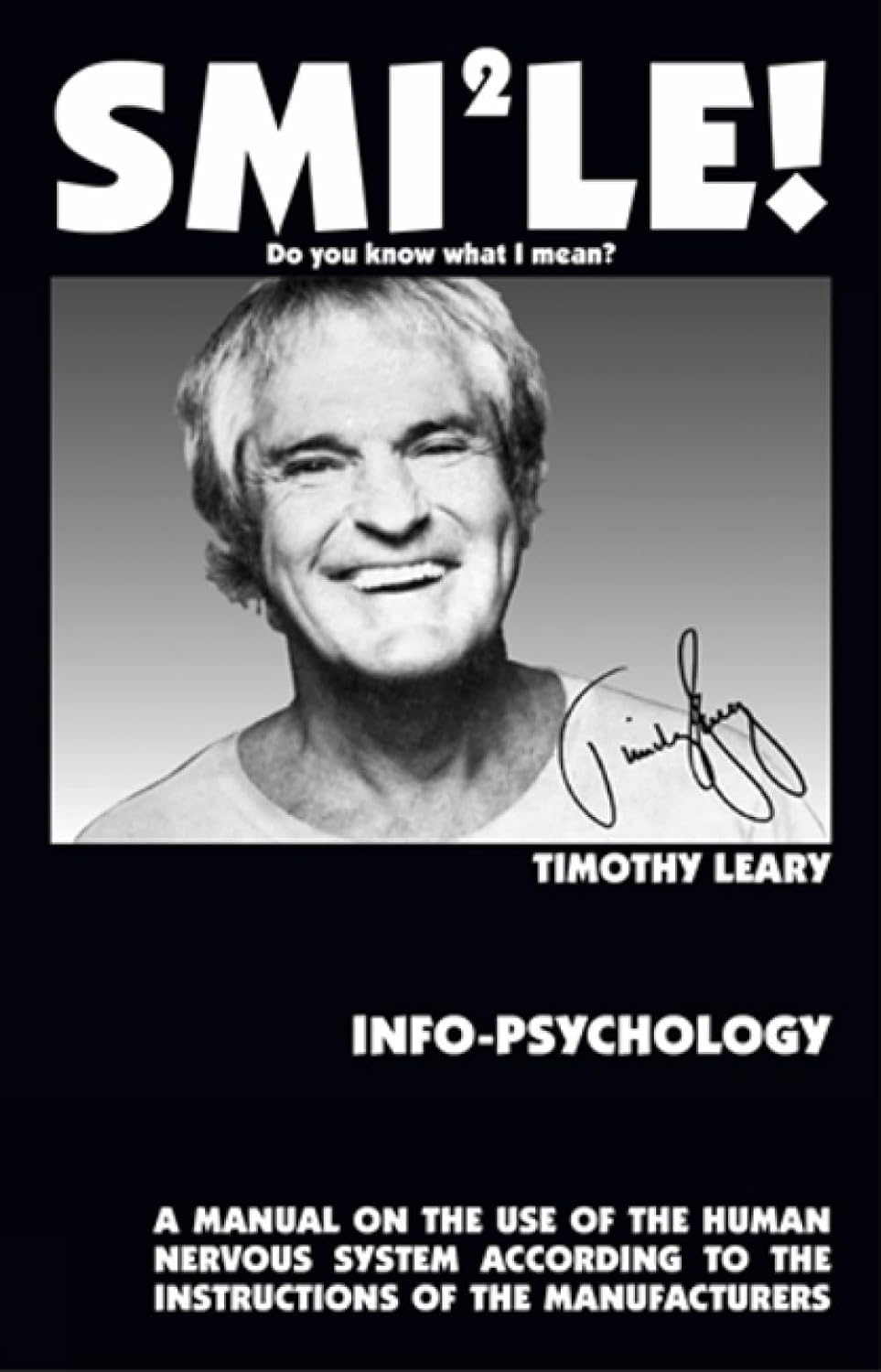
We live amid more change and information than our usual mental schemas can order, and the common response is to adapt: follow inherited norms and repeat what already works. Timothy Leary, who wrote the first version of this book in prison, argues that this is the problem: the psychology of his day taught people to fit into a frame of reality rather than learn to steer it. Following his argument shows what he proposes instead, and where he sets his own limits.
Leary drafted the original manuscript while serving a sentence in a federal prison, and he ironically called it a “government-grant of undistracted time.” For the 1987 edition he shifted the focus from outer space to information space. The book matters at Eudaimanya as an ambitious, provocative proposal about the autonomy of the mind; this analysis treats it as a speculative philosophical proposal, not as a confirmed neuroscientific model.
If you remember only one idea
For Leary, we live inside a reality tunnel fixed by early imprints, and he proposes learning to steer our own nervous system instead of merely adapting.
- An imprint is a rapid fixation during a sensitive period of development; according to Leary, it sets the limits of what is perceived, and conditioning operates only inside that frame.
- “Cybernetic” comes from the Greek kubernetes, helmsman: for the author, it describes someone who takes the helm of their own mind and responsibility for the realities they inhabit.
- The framework is a speculative philosophical proposal, with its own warnings about its traps, and not a confirmed neuroscientific model.
Audiovisual analysis
Audiovisual summary and podcast on the book’s central ideas.
Key concepts
Seven ideas for entering Info-Psychology
Before the analysis, it helps to pin down the basic vocabulary Leary uses to describe how a personal reality is formed and who can steer it.
Reality tunnel
What it means: The frame through which each person perceives and interprets, shaped by imprints and conditioning: it determines what is noticed and what is ignored.
Why it matters: According to Leary, it is what limits each person’s reality, and what his proposal for steering the nervous system aims to change.
Imprint (imprinting)
What it means: A rapid fixation, in a single exposure during a sensitive period of development, which according to Leary sets the limits of the reality tunnel.
Why it matters: In his model, it is the deep cause of people remaining bound to local, tribal or state-level frames.
Conditioning
What it means: The formation of habits and associations, through reward and punishment, within the frame an imprint has already fixed.
Why it matters: Leary holds that, on its own, it cannot alter or dissolve an imprint.
Re-imprinting
What it means: In Leary’s model, the suspension and redefinition of the primary frame of reality, which would require biochemical agents or neuro-electronic technologies.
Why it matters: It is the route the author proposes for changing what conditioning cannot reach, within a speculative framework.
Cyber-person
What it means: From the Greek kubernetes, helmsman: someone who, according to Leary, steers their own nervous system and takes responsibility for the realities they define and inhabit.
Why it matters: It is the figure the book sets against the “larval” person, bound to the mechanical conditioning of their surroundings.
Info-space
What it means: The universe of experience and data that the nervous system perceives, processes and transmits, including its electronic extensions.
Why it matters: It marks the book’s turn: from imagining migration into outer space to mastering information space.
Larval and domesticated primates
What it means: Satirical terms Leary uses for people who lack self-management and depend on collective conditioning.
Why it matters: They are the author’s provocation, not a clinical diagnosis: reading them that way keeps the book’s tone from being mistaken for a judgment on people.
The book’s path
Problem
An environment that changes faster than our models of reality
Common error
Mistaking social adaptation for development
Thesis
A reality tunnel fixed by imprints, which can be learned to steer
Framework
8 periods, 24 stages; imprinting, conditioning and re-imprinting
Application
Ask which frame filters what I perceive, and what is merely habit
Outcome
Cybernetic self-management, according to the author
01 — Central thesis
Steering Instead of Adapting
When change and information arrive faster than the schemas we use to understand them, the usual reaction is to adapt: follow inherited norms and repeat what already works. Adaptation then starts to look like a sign that things are going well.
In Leary’s diagnosis, that was the belief behind the psychology of the industrial era (1850–1975): an objective science of mind and behavior whose job was to measure adaptation or maladaptation to social rituals.
Leary breaks with that reading. He calls it a “technological/priestly religion” which, in pseudoscientific language, reinforced the factory society instead of promoting neurological evolution, and which failed to solve ills such as war, crime and alienation. He adds that the crisis of his time is not one of material resources but a neuro-political one: a conflict arising from not knowing how to steer one’s own nervous system amid a growing flow of information.
Central thesis
According to Leary, we live inside a “reality tunnel” fixed by early imprints and reinforced by collective conditioning; the evolutionary task is to learn to steer our own nervous system instead of merely adapting.
The word “cybernetic” comes from the Greek kubernetes, “helmsman.” In the book it describes someone who, rather than passively receiving the pressures of their surroundings, actively navigates and shapes their own reality.
Leary sets that figure against the “larval” phase, a satirical term he uses for those who lack self-management and depend on the mechanical conditioning of their surroundings. It is a stylistic provocation, not a clinical diagnosis.
The rest of the analysis follows that thread: how the frame gets fixed, how the book orders the evolutionary path, what changed between 1975 and 1987, and where the framework itself sets its limits.
02 — Main mechanism
Imprinting, Conditioning and Re-imprinting
Many people see the world in a certain way without remembering having decided to. Leary offers an explanation on two levels: what fixes the frame, and what happens inside it.
The usual mistake would be to assume that piling up new habits, through rewards and punishments, is enough to change any way of seeing reality.
In the author’s model, an imprint is a rapid, primary fixation: it happens in a single exposure, during a critical or sensitive period of development, and it determines almost indelibly which stimuli will be perceived and which ignored.
Conditioning is something else: it consists of learning associations and habits, through rewards and punishments, within the frame the imprint has already fixed. Leary’s thesis is that conditioning, on its own, cannot alter an imprint.
If habit is not enough, what could change the frame? Leary calls it re-imprinting: the suspension and redefinition of the primary frame. He holds that, because the imprint is recorded in neurochemical tissue, it could only be modified by biochemical agents—including psychoactive substances or neurotransmitters—or by neuro-electronic technologies that restore plasticity to the nervous system. This is a claim by the author within a speculative framework, and it is described here as such.
The diagram below shows how these three processes relate in Leary’s formulation.
The book describes a fourth process, reprogramming and metaprogramming: the cyber-person’s conscious ability to analyze and redesign the “programs” run by their brain circuits and to choose their models of reality deliberately.
The consequence, in Leary’s model, is that autonomy is not a matter of repeating habits: it requires acting on the frame that contains them.
03 — Core components
Twenty-Four Stages in Eight Periods
If the frame is fixed during development, one may ask where the nervous system can evolve from there. Leary answers with a scheme that, unlike other ideas in the book, has a name and numbering of its own: the “Periodic Table of Evolution.”
According to the book, the table distinguishes twenty-four stages of neurological evolution, grouped into eight periods and two major phases: twelve terrestrial, collective and mechanical stages, and twelve post-terrestrial ones of a cyber-quantum character. This organization is the author’s own, not a reconstruction by Eudaimanya.
Terrestrial, collective and mechanical phase (periods 1 to 4)
According to Leary, it covers the stages oriented toward biological survival and toward the cohesion of tribal, symbolic and industrial structures. Its dynamics are mechanical and governed by collective conditioning; this is the phase he calls “larval.”
01
Bio-survival (marine)
Stages 1 to 3: invertebrate, marine vertebrate and amphibian.
02
Terrestrial mammal
Stages 4 to 6: evasive mammal, predator mammal and hunter-gatherer.
03
Symbolic tool
Stages 7 to 9: tool user (Paleolithic), tool maker (Neolithic) and tribal (Metal Age).
04
Industrial
Stages 10 to 12: feudal, national (low industrial) and multinational (high industrial).
Post-terrestrial, cyber-quantum and individual phase (periods 5 to 8)
According to the book, it represents emancipation from terrestrial collectives and individual mastery of sensory, electronic, genetic and atomic information. In it, the person operates as the autonomous pilot of their own neurological circuits.
05
Cyber-somatic
Piloting of sensory information. Stages 13 to 15: individual consumer hedonism, individual aesthetic mastery and hedonic-aesthetic linkage.
06
Cyber-electronic
Piloting of electronic information. Stages 16 to 18: individual access to the brain and to electronic technology, individual mastery, and neuro-electronic networks.
07
Cyber-genetic
Piloting of DNA and RNA data. Stages 19 to 21: brain management through genetic technology, individual mastery of that information, and its linkage in networks.
08
Cyber-nanotechnological
Piloting of atomic information. Stages 22 to 24: individual access to nanotechnology, individual mastery, and nanotechnological linkage.
A note on provenance: these eight periods and twenty-four stages are the explicit structure of Info-Psychology (1987). The so-called Eight-Circuit Model comes from Brainmodel, a companion document by Leary and Robert Anton Wilson, and its combination with Gurdjieff’s centers and other correlations is an editorial reconstruction by Eudaimanya, not part of the book’s structure.
04 — Deeper layer
From Outer Space to Information Space
A book has a biography too. Leary wrote the original manuscript in 1975–1976, in a federal prison, after a conviction for possession of half an ounce of marijuana, and titled it Exo-Psychology. His paradigm at the time rested human mutation on escaping Earth’s “gravity well” by means of rockets and space colonies in high orbit. The author himself admits that his “caged” state may partly explain those yearnings for flight.
For the revised 1987 edition he changed the axis. According to Leary, the arrival of personal computers, and his observation in 1979 of his son Zachary—whom he calls “Cyber-son”—moving through the information space of video games, showed him that this space could be reached from home screens, not only from launch pads. The preface sums up the change: from space habitats to information habitats.
The diagram contrasts the two paradigms.
The shift brings one more idea with it. In Info-Psychology, Leary describes the universe not as solid matter but as data structures, binary digits and packets of information (quanta). He calls this Info-Physics and sets it against Newtonian physics, with its mass, force and mechanical energy.
From this follows his quantum linguistics: a “post-symbolic” thought that processes quantitative patterns instead of alphabetic words. His example is that H₂O expresses in digital form what “water,” “Wasser” or “eau” express in letters.
The nervous system thus stops being merely the source of consciousness, memory and behavior and becomes something one can learn to direct. Leary puts it through an analogy of his own: a “bio-computer” of a hundred billion cells, of which the body is a “transport robot.” According to the author, whoever manages to tune and coordinate their receptive, integrative and transmitting circuits operates at a higher evolutionary level.
05 — Limits and failure conditions
Traps, Risks and the Status of the Framework
A framework that proposes steering one’s own nervous system needs clear limits. The book’s materials and its companion document point to several.
Taking pleasure as the goal
Brainmodel warns that bodily pleasures are “a means and not an end.” In the model, anyone who reduces development to the sensory pleasure of period 5 stops there.
Getting lost in the screens
In period 6, according to Brainmodel, a person may “lose sight in the glitter of the glass beads,” an allusion to the Glass Bead Game. The tool becomes a loop that turns on itself, and development does not advance toward the genetic and atomic periods.
Caution around collectives
Theses 26 and 27 call for extreme caution when communicating with “larval” humans and with “premature post-larvals.” Leary holds that exposing these models of reality to domesticated collectives provokes defensive reactions, institutional persecution and reprisals.
A speculative framework
Eudaimanya classifies the book as a speculative philosophical design, not a confirmed neuroscientific model. That DNA is a script for a galactic destiny, or that embryonic development literally repeats the evolution of the species, are the author’s hypotheses, without contemporary empirical support.
There is also a precondition: according to the book, the higher stages require taking on the role of the cyber-person and having technologies for digital and quantum information processing.
And one caution about how to read. The edition’s preface, signed by Christopher Hyatt, argues that neurosis, anxiety and depression are attempts to cope with change and information overload in models of reality. That is the preface’s framing, not a clinical conclusion the materials support as established.
06 — Application
Questions for Using the Framework
Info-Psychology offers no step-by-step method for daily life, and its most operational mechanisms belong to a speculative framework. What it does allow is using its concepts as questions for reading. The four below are a selection by Eudaimanya, not a protocol from the author.
01
Which frame filters what I perceive?
Move from “am I adapting well?” to asking about the reality tunnel through which events are interpreted.
02
Is it a habit or the frame?
According to Leary, conditioning operates within the imprint: repeating behaviors is not the same as changing the frame that contains them.
03
Is it a means or an end?
Brainmodel warns against taking pleasure as the goal and against getting lost in electronic fascination: both are paths, not destinations.
04
Which reality do I define and inhabit?
The cyber-person, according to the book, takes responsibility for the realities they define and inhabit, rather than receiving them unexamined.
The route of re-imprinting that the book mentions is not included as an exercise: it belongs to the author’s speculative framework and is described in this analysis, not recommended.
What to remember
- For Leary, industrial-era psychology measured adaptation to social rituals without promoting neurological evolution.
- An imprint is fixed in a single exposure and, according to the author, sets which reality is perceived.
- Conditioning adds habits within that frame; according to Leary, it cannot change the frame on its own.
- “Cybernetic” means steering: taking the helm of one’s own mind and responsibility for the realities one inhabits.
- The framework is a speculative philosophical proposal; the eight periods and twenty-four stages are its explicit structure.
What the book does not say
It is not a manual for reprogramming oneself with substances. Leary mentions biochemical agents as a route to re-imprinting within a speculative framework; the table of eight circuits with associated substances comes from Brainmodel and is an editorial reconstruction by Eudaimanya, not a structure of Info-Psychology.
Nor is it a theory of inferior people: “larval” and “domesticated primates” are the author’s satirical terms, born of his provocative tone and his prison isolation, not diagnoses or clinical hierarchies.
Synthesis
From Adjustment to the Helm
Taken as a whole, Info-Psychology changes the question we put to the mind. Instead of asking how well a person adapts to their environment, Leary asks which frame of reality imprints have fixed in them, and whether they can learn to steer it. Hence his figure of the cyber-person, who takes the helm of their own nervous system.
The proposal grows out of a crisis the author describes as neuro-political, and out of a personal and technological shift from outer space to information space. Its scope is that of a speculative philosophical design, with warnings of its own about the traps of pleasure, of screens, and of clashing with collectives.
If imprints are laid down by accident, how much responsibility do we have for steering a reality no one chose?