
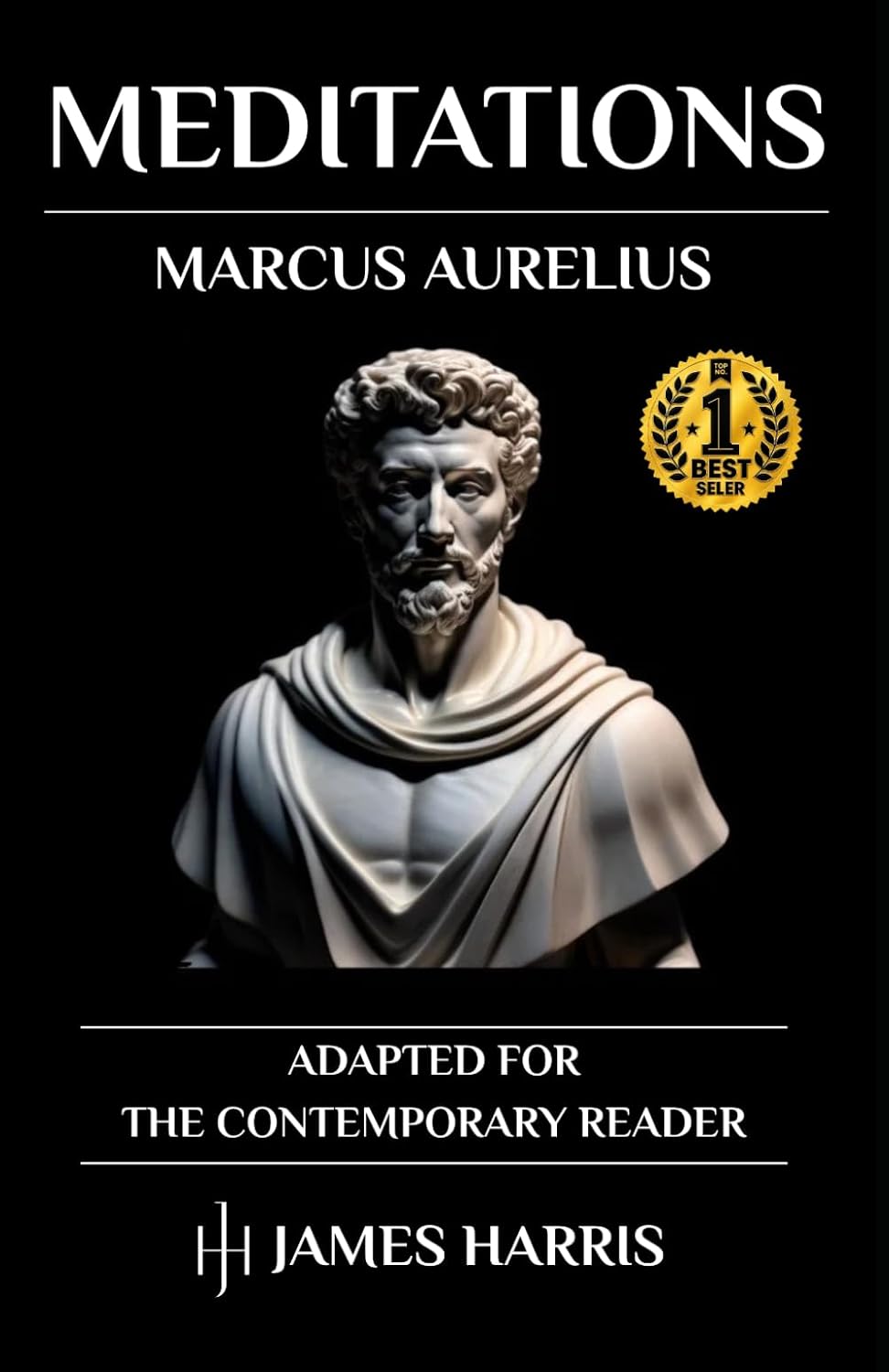
An ungrateful person, a plan that falls apart, worry about what others will say of us: we tend to feel that the cause of our distress lies outside us. Marcus Aurelius, who wrote these notes to himself during military campaigns, holds that it begins in the judgment we add to events. Following his reasoning helps us tell apart what happens from what we decide to believe about it.
The Meditations are private reflections jotted down in notebooks, not a treatise written for the public. They matter at Eudaimanya because they show how a ruler understands serenity: not as withdrawal from the world, but as a discipline practiced in the midst of duty. The organization this analysis follows is an editorial reconstruction by Eudaimanya, not a division the author proposed.
If you remember only one idea
For Marcus Aurelius, serenity does not depend on events changing, but on how we judge what happens and how we act in response.
- Events stay outside the mind; according to the author, what disturbs us is the judgment we add to them, and that judgment can be examined.
- Whoever wrongs us acts out of ignorance of good and evil and shares reason with us: the right response is justice, not anger.
- We possess only the present, and in the book's view whatever happens belongs to a natural order worth accepting.
Audiovisual analysis
Audiovisual summary and podcast on the book’s central ideas.
Key concepts
Six ideas for reading Marcus Aurelius
Before turning to the analysis, it helps to settle the minimum vocabulary the author uses to speak about the mind, about other people, and about the world.
Judgment about what happens
What it means: The value the mind attaches to an event and accepts as true: “this harms me,” “this is a good.”
Why it matters: According to Marcus Aurelius, this is where distress begins, and it is the ground we can actually govern.
Impression (phantasia)
What it means: The first appearance an event leaves in the mind, before we decide whether to believe it.
Why it matters: Examining it before giving it credit is, in the book, the starting exercise of self-government.
Indifferent things (adiaphora)
What it means: Health, wealth, fame, illness, or death: in the author's view, none of them is good or bad in itself.
Why it matters: They are the material on which virtue or vice acts, and they should not decide our peace of mind.
Ruling principle (hegemonikon)
What it means: The part of the mind that examines impressions, governs impulses, and makes decisions.
Why it matters: It is what the book seeks to keep steady against the body, the passions, and circumstances.
Rational community
What it means: For the author, all beings with reason share one law and are citizens of a common city.
Why it matters: It holds that serving others is not an add-on but part of living in accordance with reason.
Universal nature
What it means: The ordered whole of everything that exists, which the author conceives as governed by a providential reason and of which every being is a part.
Why it matters: It underpins acceptance: what happens to the part serves, according to the book, the harmony of the whole.
The book's path
Problem
Distress at what others do and what happens to us
Common mistake
Believing the harm comes from the event itself
Thesis
What disturbs us is the judgment we add
Framework
Judgment, duty to others, and acceptance (editorial grouping)
Application
Examine, anticipate, act with reservation, and retreat inward
Outcome
A calm and just life, according to the author
01 — Central thesis
Not events, but judgment
When someone wrongs us or a situation turns difficult, the experience feels instantaneous: the event arrives and, with it, the distress, as if the two were one thing. The usual belief is that what upsets us comes from outside: from what others do, from what happens to us, from what people think of us.
Marcus Aurelius proposes pulling the two apart. For him, the event itself is indifferent: neither good nor bad. What gives it weight is the judgment the mind adds and accepts as valid.
Central thesis
Things themselves do not touch the soul; they stay outside, quiet and motionless, and all the turmoil comes from the opinion within.
— Marcus Aurelius, Meditations
The clearest example is the sense of being wronged. According to the book, if you remove the opinion “I have been harmed,” the harm is removed too. The line does not deny that someone acted badly; it proposes that we not add to the event a judgment that makes it worse.
This sets the task for the rest of the analysis: learning to examine what the mind receives before taking it as true.
02 — Main mechanism
Examine before assenting
A cutting remark, a tempting feast, a pain that arrives: the reaction tends to come before the thought. We feel first and judge afterward, or we believe the two are one.
The usual mistake is to accept the first appearance as it stands. Marcus Aurelius adds an intermediate step: the impression an event produces should not be accepted without examination, because what the mind approves is what later disturbs it.
For that examination, the book offers a simple way of looking: break down whatever dazzles us into its raw material. Falernian wine is grape juice; the purple robe is sheep's wool dyed with the blood of a shellfish. The author praises the usefulness of such images because they cut through things and reveal their nature.
The diagram below shows the fork the author describes: the same event can follow two paths, depending on whether the impression is approved outright or examined first.
The point is not to feel less, but to examine more. According to the book, once judgment has been examined, the mind is in a position to act with integrity and composure in the face of adversity.
03 — Main components
Judgment, duty, and acceptance
Marcus Aurelius's notes follow no systematic order. To explain them clearly, Eudaimanya groups them into three areas. This is an editorial reconstruction: the author neither names nor numbers them this way.
1
Governing judgment
It means examining impressions before giving them credit and keeping the ruling principle steady. The author regards anger as a lapse that runs against the social nature of human beings and clouds the ability to discern; for that reason, giving it up is, in his view, an ethical duty.
2
Acting in service of others
Actions are directed toward the community, with justice and goodwill. Marcus Aurelius states that we are born to cooperate, like feet, hands, or the rows of upper and lower teeth, and that good should be done without expecting applause, like the bee that, once its honey is made, moves on to something else.
3
Accepting the natural order
It means bringing one's will into line with what universal nature assigns to each of us. The book goes so far as to ask that we embrace whatever fate brings, because, in the author's view, what happens to the part is necessary to the harmony of the whole.
Taken together, these three areas answer three everyday questions: how to interpret what happens, how to treat other people, and how to receive the inevitable. The division is Eudaimanya's; the ideas are Marcus Aurelius's.
04 — Deeper layer
A part within a whole
Someone who has been wronged tends to feel that the wrongdoer stands outside their world. Marcus Aurelius thinks the opposite: according to the book, the one who does wrong shares reason with us and belongs to the same community.
That idea rests on a wider outlook. For the author, rational beings take part in one and the same reason and therefore in one and the same law; hence they are fellow citizens of a common city.
If reason is common to us, then the reason that tells us what to do and what not to do is common too; if so, the law is common; if so, we are fellow citizens.
Marcus Aurelius, Meditations
The next diagram shows this belonging in layers: each person is part of a community of rational beings, and that community is in turn part of universal nature.
The community, in turn, sits within a larger order. Marcus Aurelius poses a dilemma—either providence or atoms—and chooses a structured cosmos, which he conceives as a single living organism. From that premise, what happens to each part serves the whole, and death is described as a change: matter dissolves and returns to the rational substance it came from.
Time enters here as well. According to the author, no one loses any life other than the one they are living: we hold only the present moment, and so the longest life and the shortest are made equal before it.
This layer explains why the book does not separate personal calm from how we treat others, or from accepting what comes: all three start from the same belonging to a whole.
05 — Limits and conditions of failure
Where the approach reaches its limits
A discipline presented as infallible would no longer be rigorous. The text itself marks out its limits, and they are worth reading before applying anything.
When the mind itself fails
Marcus Aurelius warns that if old age or illness impairs the ability to judge before death, we lose the capacity to weigh things and to apply his principles. The approach assumes a mind able to examine.
Anger does not correct others
In this model, we cannot change other people's ignorance or malice by wishing it away. Success is therefore measured by control over one's own judgment, not by whether others behave differently.
The temptation of power
The author warns against the danger of becoming just another Caesar. The luxury and flattery of the court can smother sobriety if inner vigilance is not kept up constantly.
A starting premise
The book poses a dilemma—providence or atoms—and chooses the first. The acceptance of fate, in particular, rests on that choice, which the text takes as its starting point.
These limits define the scope of the approach: it works on one's own judgment and conduct, not on other people's judgment or on the course of events.
06 — Application
Exercises in attention
The book does not offer a step-by-step method. It gathers exercises in attention scattered throughout the notes. Eudaimanya selects four here and arranges them by the moment in which they are used; they are not a sequence the author proposes.
01
At the start of the day
Anticipate dealing with difficult people by remembering that they act out of ignorance of good and evil, and that they share reason with us. A wrong stops being a reason for anger.
02
Before what dazzles
Break down the object of desire into its raw material, as with wine into grape juice or the robe into dyed wool. This strips away the pomp that feeds vanity.
03
When acting
Undertake every task with a reservation: if something prevents it, the obstacle becomes material for patience or firmness. What stood in the way becomes the way.
04
In the midst of turmoil
Withdraw into your own soul at any moment, without abandoning your duty. The book does not recommend physical isolation, but an inward retreat that lets you return to the task without bitterness.
Other practices round out the picture: attending to the duty at hand with gravity, as if each act were the last; doing good without expecting applause; and receiving whatever happens as part of a larger order. What they all share is that they work on one's own judgment and conduct, which is where, according to the author, the room for choice lies.
What to remember
- According to Marcus Aurelius, events stay outside; distress comes from the judgment added to them.
- Examining an impression before giving it credit is the starting exercise.
- Whoever wrongs us acts out of ignorance and shares our common reason: the response is justice, not anger.
- According to the author, we hold only the present, and death is a natural change, not a catastrophe.
- The calm the book proposes is practiced within duty, not apart from it.
What the book does not say
It does not say we should stop feeling. The imperturbability the author describes means being freed from destructive passions such as anger, envy, or resentment, while keeping natural affection, warmth toward others, and compassion for those who go astray.
Nor does it propose withdrawing from the world: the inward retreat coexists with service to the community and with the fulfillment of public duty.
Synthesis
A calm that is practiced
Read as a whole, Marcus Aurelius's notes shift where we look for the cause of distress: from events to the judgment we add to them. From there, serenity is no longer something we expect from circumstances; according to the author, it becomes a task carried out while acting justly and accepting what falls to us.
That task is not undertaken alone: the book places it within a community of rational beings and an order of which each of us is a part, and for that reason it does not separate looking after one's own mind from how we treat others.
How can we keep our inner calm amid the demands of the world without letting it turn into a way of keeping others at a distance?