
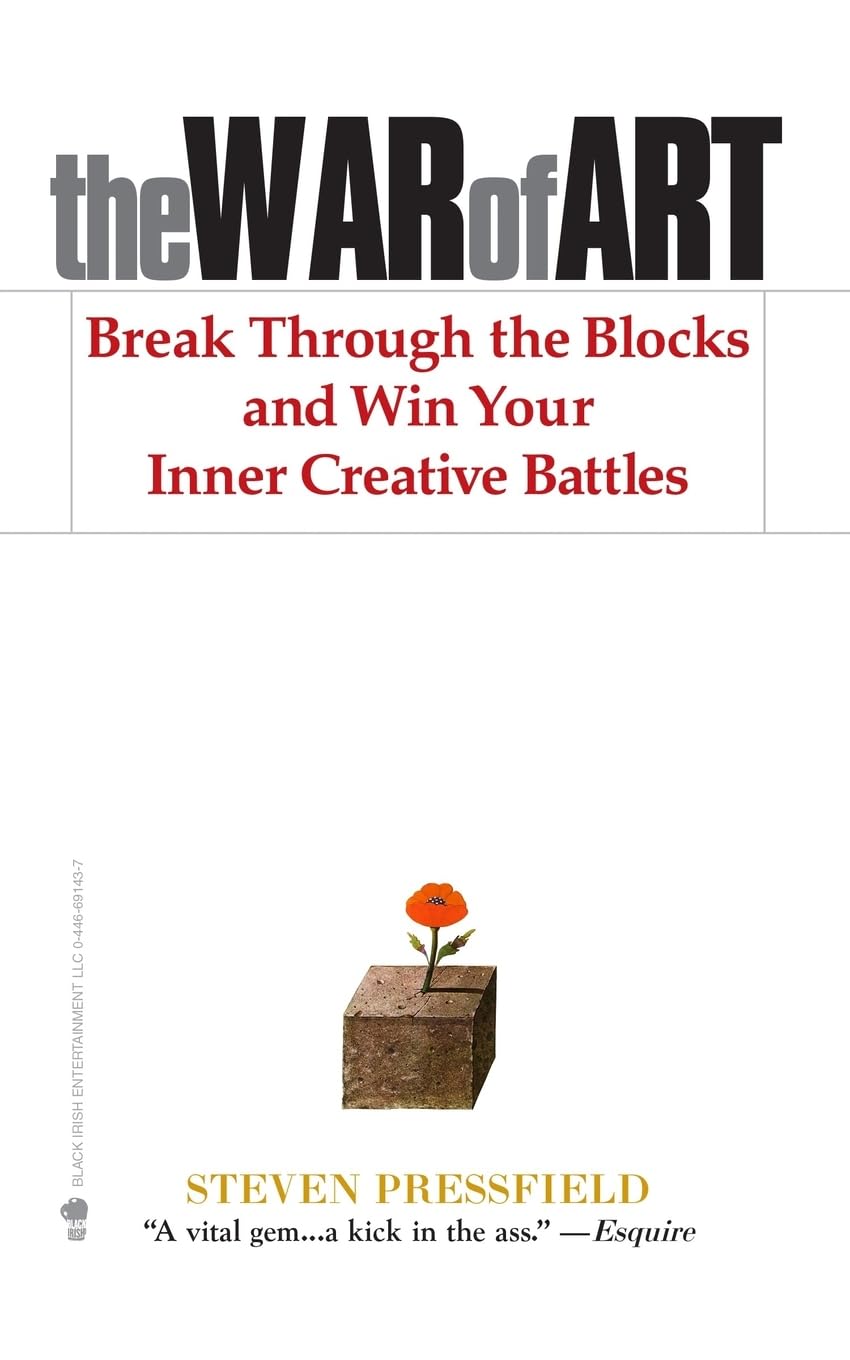
There's a project someone has been putting off for years — a book, a business, a conversation that needs to happen — always waiting for the right moment. Steven Pressfield argues that this delay has nothing to do with time or talent. It comes from an internal force that kicks in precisely when something truly matters. Understanding how that force works is where The War of Art begins.
Pressfield writes from his own years as a blocked writer, and structures the book in three parts that move from diagnosing the obstacle to the discipline needed to overcome it.
If you remember just one idea
What keeps people from creating is rarely a lack of talent. It's Resistance — an internal force everyone generates against themselves, one that intensifies precisely around what matters most to them.
- Resistance is internal, not an external obstacle, and it grows with how much the activity matters.
- The professional shows up to work every day regardless of mood, and doesn't control the outcome.
- Sabotage intensifies near the end of a project, not at the beginning.
Audiovisual analysis
Audiovisual summary and podcast on the book’s central ideas.
Before we continue
Six ideas for understanding the book
Pressfield builds his argument on a vocabulary of his own. These six terms recur throughout the analysis and are worth keeping in mind from the start.
Resistance
What it means: an internal force, universal according to the author, that opposes any act that springs from a person's true calling.
Why it matters: recognizing it as internal completely changes where the effort to overcome it needs to go.
Genius
What it means: in the original Roman sense the author draws on, the inner spirit that guides a person's true calling.
Why it matters: in the author's model, Resistance is described as the shadow this impulse casts.
Professional / Amateur
What it means: two possible identities toward one's work — one built on discipline and detachment, the other on mood and outside approval.
Why it matters: this, the book argues, is what separates sticking with a project from abandoning it.
Territory / Hierarchy
What it means: two ways of relating to one's craft — drawing sustenance from the work itself, or from other people's recognition.
Why it matters: it explains why relying on outside validation can quietly erode commitment.
Ego / Self
What it means: two planes of consciousness in the author's model — one tied to Resistance, the other described as deeper.
Why it matters: this, according to Pressfield, is where the shift that makes creating possible takes place.
Muse / Angels
What it means: within the author's symbolic framework, forces that intervene once sustained technical commitment is in place.
Why it matters: they express the spiritual dimension Pressfield attributes to the act of creating.
The book's arc
Problem
Important projects postponed indefinitely
Common mistake
Blaming the delay on lack of time, talent, or motivation
Thesis
Resistance is an internal force, not an external obstacle
Framework
Diagnosing Resistance and the professional's discipline
Application
Showing up to work regardless of mood or outcome
Outcome
Sustaining the project through its peaks of internal sabotage
01 — Central thesis
The force that sabotages from within
Someone has spent months, even years, putting off the project that matters most to them: the book, the business, the change of direction. They usually explain it away as a lack of time, talent, or the right conditions.
Steven Pressfield offers a different explanation: that delay isn't a one-off failure of willpower. It's the effect of an internal force he calls Resistance. According to the author, this force has nothing to do with external circumstances — it shows up precisely when something matters enough to transform the person doing it.
Central thesis
Most of us have two lives, the life we live, and the unlived life within us.
— Steven Pressfield, The War of Art
To show how far this surrender can go, the author reaches for a deliberately extreme example: he claims that for Adolf Hitler, starting a world war was easier than facing a blank canvas. It's a stark image, characteristic of Pressfield's style, meant to show that Resistance doesn't scale with talent — it scales with how much the abandoned calling matters.
02 — Mechanism
Why it hits harder the more it matters
It's tempting to assume that resistance to starting something scales with how technically difficult it is. Everyday experience suggests the opposite: it's harder to sit down and write the first page of a project of your own than to plow through routine emails.
In Pressfield's model, that's no accident: the intensity of Resistance is directly proportional to how much the activity matters to a person's growth. The more significant the project, the stronger the pull to put it off.
Two mechanisms sustain this block. Procrastination here doesn't mean flatly refusing the project — it means endlessly pushing back its start: no one tells themselves "I'll never do this," they tell themselves "I'll start tomorrow." Rationalization here means finding reasons that are legitimate in themselves but beside the point of the calling, dressing up avoidance as sound logic.
As a result, the obstacle rarely announces itself as an outright "no." It shows up as a reasonable postponement, repeated indefinitely.
03 — Traits
The traits of Resistance
Pressfield describes Resistance through a set of traits that, taken together, explain why it's so hard to recognize and so hard to beat.
01
Internal
According to the author, it doesn't come from bosses, partners, or circumstance: the person generates and sustains it themselves.
02
Insidious
It takes whatever form is needed — reasoning, seduction, pressure — to get the project abandoned.
03
Relentless
The author compares it to a machine that never yields or negotiates; it doesn't wear down and it doesn't respond to argument.
04
Unerring
In the author's model, its intensity works like a compass: it points with precision to what matters most to the person feeling it.
04 — Deeper layer
Ego and Self: two centers of gravity
So far, Resistance looks like an obstacle to be defeated. Pressfield adds another layer: an account of why, in his view, that obstacle makes sense within a wider map of identity.
In the author's model, the Ego is the plane where Resistance lives — tied to time, comparison, and the need for approval. The Self, in that same model, is a deeper plane, linked to what Pressfield calls Genius: the inner impulse that orients a person's true calling. Creating requires, according to the author, shifting the center of gravity of consciousness from the Ego to the Self.
Pressfield takes this further into explicitly metaphysical territory: he holds that when a person sustains technical commitment, forces he calls Muse and Angels intervene from what he describes as the plane of Eternity. This is the author's own formulation — spiritual in nature and not verifiable — best read as part of his symbolic framework rather than as a description of proven mechanisms.
05 — Friction
When and how the system fails
The book itself points to moments and readings where this framework can fail or be misread.
Sabotage near the finish line
Pressfield argues that Resistance intensifies right before a project's completion, not at its start — the moment it feels safest to relax is, in the author's view, the most dangerous one.
Fighting the wrong enemy
Looking for the cause of the block in outside circumstances — a boss, a partner, bad timing — pulls effort away from where the author locates the real source of the problem.
"Professional" isn't about income
The book defines "professional" as an operating identity, not an income level; reading it as a promise of commercial success misreads the argument.
An explicit limit on Resistance
According to the author, this force only opposes movement toward a higher calling — it doesn't intervene if someone abandons a meaningful project for one that demands less of them personally.
It's also worth not taking literally the catalog of ills Pressfield attributes to Resistance — from substance abuse to minor physical complaints. It's a rhetorical flourish meant to convey scale, not an established causal claim.
06 — Application
How to work against Resistance
Pressfield doesn't offer a numbered method, but he does return again and again to certain criteria for sustaining the work day to day. Organized for practical use, they fall into four areas of focus.
01
Show up unconditionally
Go to work every day without waiting to feel inspired or in the mood — consistency stands in for motivation.
02
Let go of the outcome
Separate the right to the work from the right to its fruits: external success or failure doesn't decide whether you continue.
03
Stand in the territory, not the hierarchy
Draw sustenance from the craft itself rather than outside approval, especially when that approval is slow to come or absent.
04
Watch the home stretch
Pay particular attention near the end of a project, where the author locates the greatest risk of abandonment.
What to remember
- In the author's model, Resistance is internal and grows with how much an activity matters, not with how hard it is.
- Procrastination and rationalization are the most common disguises this avoidance wears.
- Being "professional" describes a discipline of showing up and letting go of the outcome, not an income level.
- Sabotage intensifies near the end of a project, not at the beginning.
What the book doesn't say
The War of Art doesn't claim that Resistance literally causes physical illness, or that overcoming it guarantees a project's success. Nor does it propose that muses or angels verifiably exist as external entities: these are Pressfield's own formulations, symbolic and spiritual in nature, expressing his experience as a writer rather than a scientific claim or a guaranteed sequence of steps.
Synthesis
The obstacle isn't out there
Read closely, Pressfield's real contribution isn't a list of habits — it's a shift in where to look: away from circumstances, and toward the place the author insists the obstacle actually lives — in each person's relationship to what matters most to them.
That doesn't make the problem simpler. Recognizing that Resistance is internal doesn't make it easier to beat; it just changes where it makes sense to direct your attention.
If the intensity of a block points to what matters most, what does the thing you find hardest to start today reveal about you?